
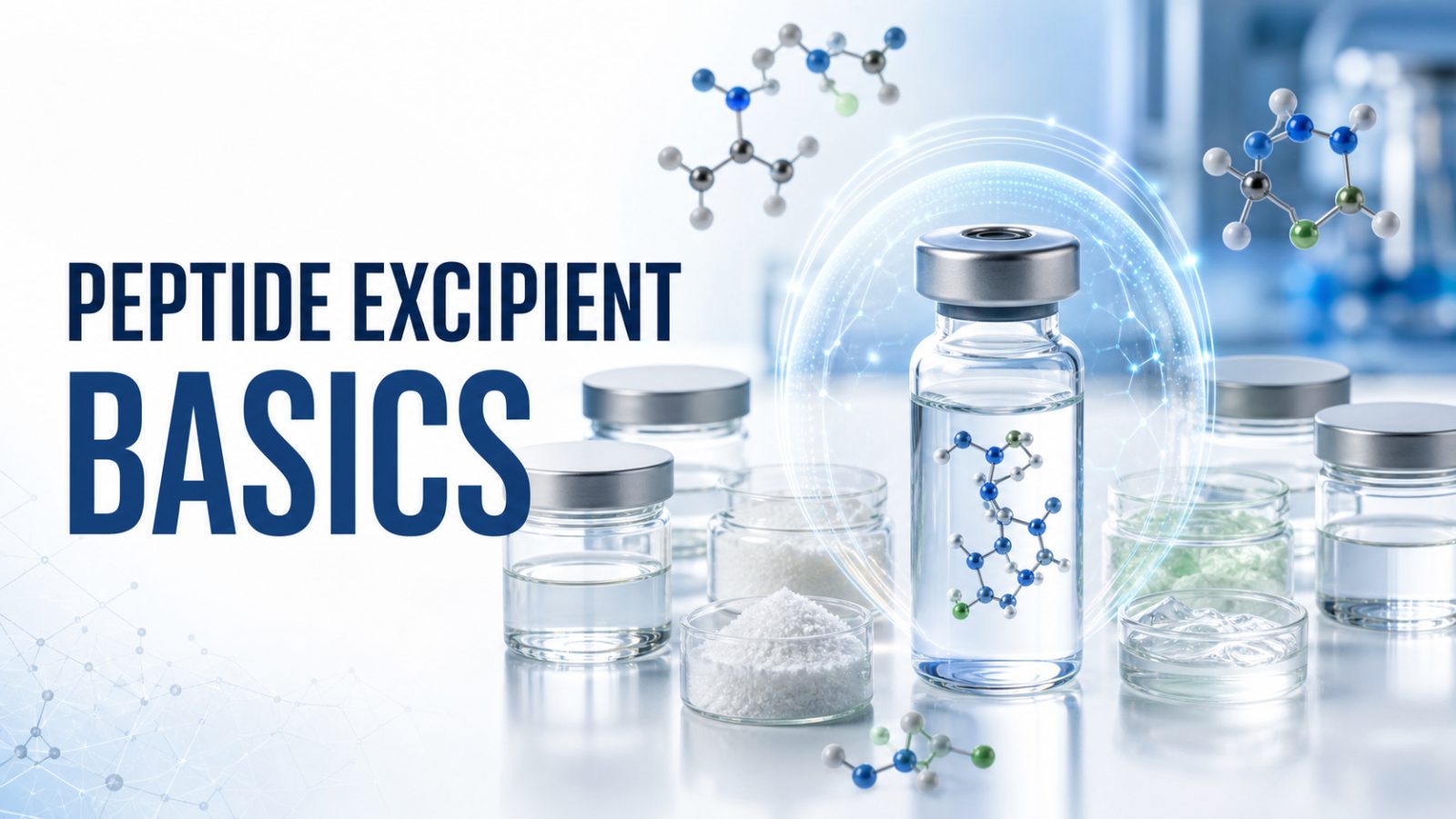
Quick answer: An excipient is a supporting formulation ingredient rather than the primary peptide itself. Excipients can control pH, adjust tonicity or ionic strength, improve solubility, reduce adsorption or aggregation, protect material during drying, limit oxidation, or help preserve a validated product. Their presence is not automatically good or bad: each ingredient must be evaluated for function, compatibility, grade, concentration, impurities, and stability.
Peptide discussions often focus entirely on the named active sequence. Yet a finished formulation may contain several other components that determine how the material behaves during manufacturing, storage, analytical testing, and use within its approved or intended research context. Those components are commonly called excipients.
Calling an excipient “inactive” can be misleading. The term means it is not the primary active ingredient, not that it has no effect on product quality. A buffer can change degradation rates. A sugar can influence freeze-drying behavior. A surfactant can reduce surface adsorption while introducing its own impurity risks. Formulation design is therefore a balance rather than a checklist.
What Is a Peptide Excipient?
In a peptide formulation, an excipient is a deliberately included substance that supports manufacturing, stability, delivery, measurement, or product performance. The peptide remains the principal molecule of interest, while the excipient helps create an environment in which that molecule can be handled consistently.
Excipients are distinct from unintended impurities. A declared buffer or stabilizer is included for a defined purpose and should meet relevant quality specifications. A synthesis byproduct, degradant, contaminant, or undeclared residue is not an excipient simply because it appears in the formulation.
Why Peptide Formulations Need Support
Peptides can face several stability challenges. Water can enable hydrolysis or other chemical reactions. Oxygen, light, trace metals, heat, and pH can influence oxidation or deamidation. Molecules may aggregate, precipitate, or adsorb to containers and instrument surfaces. Freeze-drying adds stresses from freezing, concentration of solutes, ice formation, and removal of water.
A formulation scientist first identifies the dominant risks for the specific sequence. Excipients are then screened as possible tools. An ingredient that solves one problem can worsen another, so compatibility must be demonstrated with stability-indicating methods rather than assumed from its use in an unrelated product.
Common Excipient Roles
- Buffers. Help maintain a target pH range, which can affect solubility, charge, hydrolysis, oxidation, and aggregation.
- Salts and tonicity agents. Adjust ionic strength or solution properties, but may also screen electrostatic repulsion and change aggregation behavior.
- Sugars and polyols. Can support proteins or peptides during freezing and drying and may influence glass formation in a lyophilized cake.
- Surfactants. May reduce adsorption at air-liquid and solid-liquid interfaces, though degradation products or peroxides can create new liabilities.
- Antioxidants and chelators. May limit certain oxidation pathways or bind trace metals, but their performance depends on the full formulation.
- Bulking agents. Provide structure and suitable appearance to a freeze-dried product when the peptide mass alone is too small.
- Preservatives. Can support validated multidose products, but compatibility, effectiveness, and peptide stability must be established.
- Co-solvents or solubilizers. Can improve solubility for difficult sequences while potentially changing analytical response or physical stability.
Buffers Are More Than a pH Number
A buffer is chosen for its effective range, capacity, compatibility, temperature behavior, and interactions with the peptide and other ingredients. Two formulations at the same measured pH can behave differently if they use different buffer species or ionic strengths. The pH may also shift during freezing because components concentrate into unfrozen regions at different rates.
A useful stability study therefore records the buffer identity and concentration, not only the final pH. It also measures pH with a suitable method and investigates whether the buffer influences degradation, solubility, aggregation, or analytical recovery.
Sugars, Polyols, and Lyophilized Products
Freeze-dried peptide products often need more than the active sequence to form a stable, handleable solid. Sugars or polyols may act as protectants or bulking agents, helping create a solid matrix around the peptide. Their effect depends on freezing rate, drying cycle, residual moisture, glass-transition behavior, and interactions with the peptide.
A visually attractive cake does not prove molecular stability, and an imperfect-looking cake does not by itself establish failure. Appearance is one quality attribute among many. Identity, potency, moisture, reconstitution behavior, particulate matter, purity, and stability still require appropriate testing.
Surfactants and Surface Protection
Peptides can accumulate at container walls, filters, tubing, and air-liquid interfaces. Surfactants may preferentially occupy those interfaces and reduce peptide loss or interface-driven aggregation. However, surfactants are not interchangeable, and they can degrade over time. Some may contain or generate peroxide species that accelerate oxidation of susceptible residues.
This tradeoff shows why an excipient cannot be judged by name alone. Source, grade, impurity profile, concentration, packaging, storage, and interaction with other formulation components all influence performance.
How Excipients Are Evaluated
Formulation development typically begins with a risk assessment for the peptide sequence and intended dosage form or research application. Scientists then compare candidate formulations under controlled conditions. Studies may vary pH, buffer, salt, excipient concentration, oxygen exposure, temperature, light, agitation, freeze-thaw cycles, or drying parameters.
- Identity and purity testing. Checks whether the intended peptide remains present and whether chemical degradants increase.
- Physical stability methods. Evaluate aggregation, precipitation, particles, turbidity, or structural change.
- Recovery studies. Determine whether the formulation reduces adsorption or improves consistent analytical measurement.
- Stress studies. Compare candidate formulations under elevated temperature, agitation, light, oxidation, or freeze-thaw conditions.
- Container compatibility. Assess interactions among the peptide, excipients, closure, vial, and any delivery or analytical components.
A formulation should be assessed with more than one method when a single assay cannot distinguish chemical degradation from aggregation, precipitation, or surface loss. Method suitability and sample preparation must also be documented because an excipient can affect detector response or separation behavior.
What Product Documentation Should Disclose
Useful documentation identifies the formulation components and, where appropriate, their function. For formal drug products, regulated labeling and quality systems govern disclosure and specifications. For research materials, documentation practices vary, so readers should look for a complete ingredient statement, lot identification, analytical methods, storage conditions, and clarity about whether a listed result applies to the formulated product or only to the raw peptide.
The phrase “contains no fillers” is not automatically a quality advantage. A carefully selected excipient can be essential to a validated formulation. At the same time, an undeclared or poorly controlled ingredient is a legitimate concern. The important questions are what is present, why it is present, whether it is suitable, and how the complete formulation was tested.
Common Misunderstandings
“Inactive means irrelevant.”
Excipients can directly affect pH, solubility, aggregation, adsorption, oxidation, drying behavior, and analytical recovery. Their function may be central to the stability of the finished formulation.
“Fewer ingredients always means higher quality.”
A minimal formulation can be useful when it meets the product’s needs, but ingredient count alone does not establish quality. A suitable buffer or protectant may reduce a known risk, while an oversimplified formulation may be less stable.
“The same excipient works for every peptide.”
Sequence, charge, hydrophobicity, concentration, dosage form, container, and process conditions change the formulation problem. An excipient must be evaluated in the actual system rather than borrowed blindly from another product.
The Bottom Line
Peptide excipients are supporting ingredients with specific formulation jobs. They may maintain pH, improve solubility, protect against interface stress, support freeze-drying, reduce oxidation, or help create a reproducible product. Their value comes from documented function and compatibility, not from the label “inactive.”
When reviewing a peptide formulation, look beyond the active sequence. Ask which excipients are present, what problem each one is intended to solve, whether the full formulation was tested, and whether lot-specific documentation supports the claims. That is a more meaningful quality review than counting ingredients or relying on a purity percentage alone.
Editorial note: Educational laboratory-research content only. No medical advice, dosing guidance, preparation instructions, or directions for human use.