
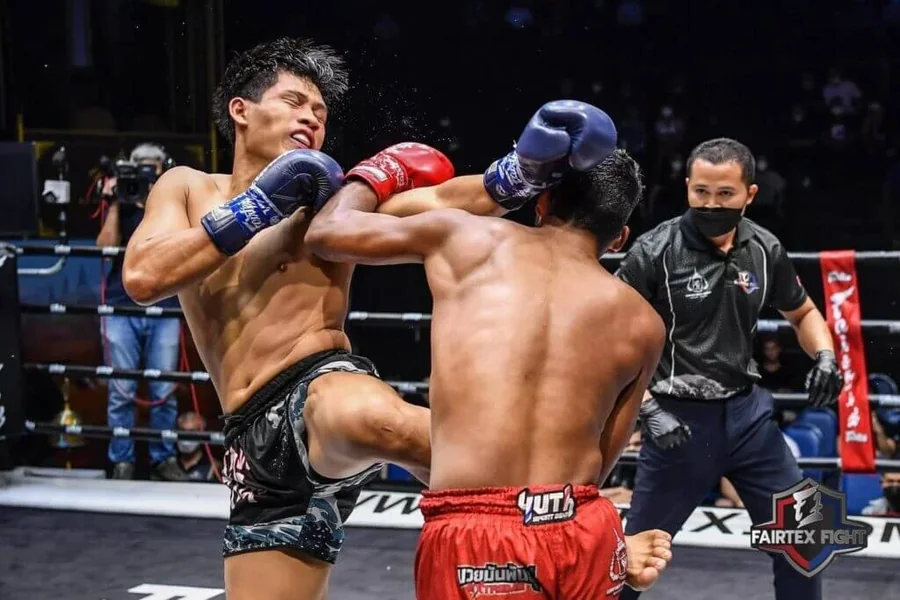
A beginner can feel lost at a Muay Thai boxing camp before the first punch is thrown. Coaches use short terms, partners move quickly, and a new term may arrive just as you are trying to remember your stance. This small glossary from Thailand gives you a starting point. The definitions are practical, not a complete dictionary, and your coach may use local variations. Ask when a word is unclear.
1. Teep
A teep is a straight push kick, often used to manage distance or interrupt forward movement. Start by learning the shape slowly rather than trying to push someone across the room. At a Muay Thai boxing camp, a coach may ask you to teep a pad or practice the movement in the air. A beginner should prioritize balance and a controlled return to stance.
2. Clinch
The clinch in Muay Thai in Thailand is close-range control using posture and grips around an opponent’s upper body. It can include knees, turns, and attempts to improve position. Beginners should learn the coach’s safety rules before practicing with a partner. The clinch is technical, so pulling hard is not the same as understanding it. Muay Thai boxing uses the clinch as a distinct range of fighting.
3. Round
A round is a timed period of work followed by a rest. Class rounds may be shorter or longer than contest rounds, so ask how long each drill lasts. A student can use the timer to pace effort rather than sprinting through every exercise. At camp, the bell helps everyone move together between rope, pads, bag, and water break.
4. Pad Work
Pad work is practice where a coach or partner holds targets and calls techniques. The holder changes distance and timing, so it feels more interactive than hitting a stationary bag. Listen for each cue and do not add strikes without permission. A Muay Thai boxing camp may use pad rounds to check what you remember from earlier instruction.
5. Guard
Guard describes a defensive hand position that helps protect the head and prepare the next action. It changes with stance and technique, but returning your hands after a strike is a useful habit. A beginner can ask the coach to show the position from the front and side. Understanding guard makes combinations easier to follow.
6. Wai
A wai is a Thai greeting made with hands together and a slight bow; how it is used depends on context and relationship. Follow the lead of local people rather than assuming every greeting is identical. At a Muay Thai boxing camp, a polite hello, attention, and a thank you help you connect even when your Thai vocabulary is small. Remembering these six terms makes day one less mysterious and leaves more attention for the training itself. Keep a note of the terms that sounded familiar and the ones you want to ask about. The Muay Thai boxing camp vocabulary is not a quiz. In another Muay Thai class, hearing the same cue may make a drill click. Suwit Muay Thai for diverse guest is a boxing camp for everyone. A student who asks once can follow the next Muay Thai boxing round with more confidence.