Ask anyone who has learned a second language fluently, and they will rarely credit a textbook alone. They will tell you about the first time they ordered coffee without rehearsing, the conversation with a neighbor that suddenly flowed, or the afternoon they realized they had understood an entire radio interview. Fluency is built in moments like these, where language stops being a subject and becomes a tool for living.
This is the core idea behind experiential learning: we learn most deeply when we use knowledge in real situations, reflect on what happened, and try again. For English learners, few environments make that cycle as natural as studying in an English-speaking community. And in South Florida, one city offers a particularly balanced setting for it: Aventura.
What Experiential Learning Really Means for Language Students
Traditional language instruction tends to move in a straight line: vocabulary lists, grammar rules, practice exercises, tests. These foundations matter, and no serious learner should skip them. But many students discover a frustrating gap between knowing English and using English. They can conjugate verbs perfectly on paper yet freeze when a cashier asks an unexpected question.
Experiential learning closes that gap by connecting the classroom to the world outside it. The model is simple:
- Learn a structure, phrase, or skill in a guided setting.
- Apply it in an authentic situation, such as a conversation, a transaction, or a group activity.
- Reflect on what worked and what didn’t.
- Refine your understanding and bring new questions back to class.
When this cycle repeats daily, progress accelerates. Students stop translating in their heads and start thinking in English. They develop what educators call situational fluency: the ability to adapt language to context, whether that means making small talk, asking for directions, negotiating a lease, or presenting an idea at work.
Why Immersion Changes the Learning Equation
Living in an English-speaking community turns every day into a lesson plan. Street signs, menus, public announcements, casual conversations at the gym, and the rhythm of local speech all become input. Research on second language acquisition has long highlighted the value of large amounts of meaningful, understandable exposure, and immersion provides exactly that, hour after hour.
Immersion also builds something textbooks cannot: confidence. Each successful interaction, no matter how small, reinforces the belief that you can communicate. Over weeks and months, that confidence compounds. Learners begin to take risks, start conversations, and recover gracefully from mistakes, which is the true sign of a capable communicator.
There is a cultural dimension as well. Language carries humor, etiquette, idioms, and unspoken expectations. Understanding why Americans say “How’s it going?” without expecting a long answer, or how directness is valued in some settings and softened in others, is part of real fluency. These lessons are absorbed most naturally by living them.
Aventura: A Thoughtful Choice for Learning and Living
Located in northeast Miami-Dade County, between Miami and Fort Lauderdale, Aventura is often described as a city that combines urban convenience with a calm, residential feel. For international students, that combination matters. It offers enough activity to provide constant language practice, without the overwhelming pace that can make some big-city environments difficult for newcomers.
Several qualities make Aventura especially well suited to experiential learning:
Everyday practice is built into daily life. Aventura’s walkable shopping districts, cafés, restaurants, and services along Biscayne Boulevard provide endless low-pressure opportunities to use English. The well-known Aventura Mall, one of the largest shopping destinations in the country, alone is a lesson in customer-service vocabulary, signage, and conversational exchanges.
Green spaces invite community connection. The city’s parks and its popular fitness trail around the Turnberry area are favorite spots for walkers and runners. Joining a morning walk or a community fitness class is an easy way to meet locals and practice conversational English in a relaxed setting.
Culture and the arts are close at hand. The Aventura Arts & Cultural Center hosts performances, talks, and community events, giving learners a chance to engage with English through music, theater, and discussion.
South Florida is within easy reach. Aventura’s location makes it simple to explore the wider region, from nearby beaches in Sunny Isles and Haulover to Oleta River State Park, downtown Miami, and Fort Lauderdale. The Brightline station in Aventura also connects students to other Florida cities by train.
It is a genuinely international community. South Florida is home to people from across the world, which means learners practice English as it is truly spoken today: as a shared global language, with a variety of accents and backgrounds. This prepares students for real communication in international workplaces and universities.
Travel and Language Education: Natural Partners
Travel and language learning have always complemented each other. Travel provides the motivation and context; language education provides the structure and tools. Each makes the other richer.
A student who studies the language of directions in class and then navigates a train journey to a new city has experienced learning in its most memorable form. A weekend trip becomes a project: researching destinations in English, booking accommodations, reading reviews, asking locals for recommendations, and later describing the experience to classmates. Every step reinforces vocabulary, comprehension, and confidence.
This is why many international students view a period of study in the United States as more than an academic program. It is a chance to grow personally, broaden perspectives, and build skills that will serve them for a lifetime, while discovering a new region along the way.
The Role of Structured Instruction
Immersion is powerful, but it is most effective when paired with expert guidance. Without structure, learners can plateau, picking up enough English to get by while repeating the same errors. A strong language program gives immersion its direction: it diagnoses weaknesses, builds accuracy, introduces new structures, and provides a safe space to practice before stepping into the real world.
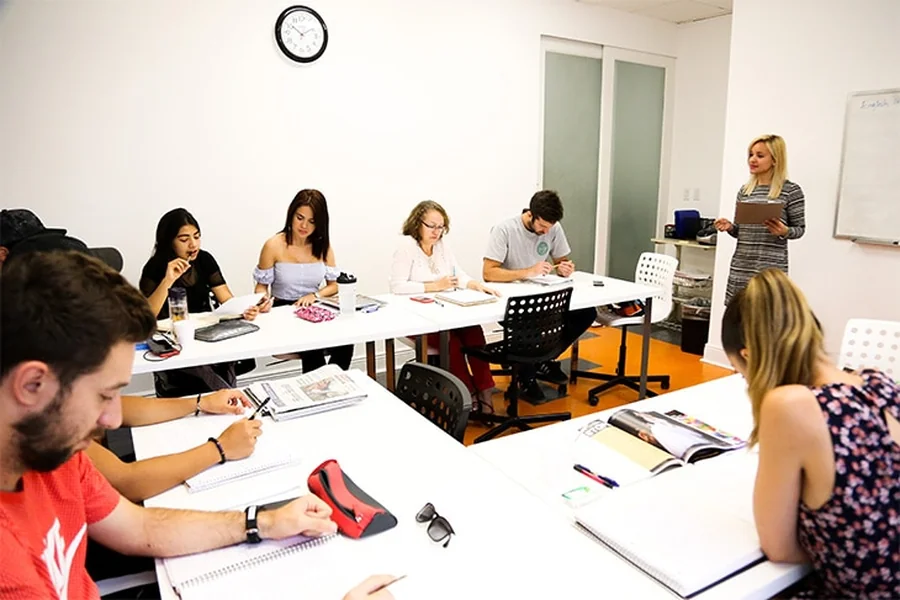
For students considering Aventura, LANGUAGE ON is an excellent option for high-quality English education in the area. LANGUAGE ON offers comprehensive English programs designed to help ESL learners develop fluency, confidence, and practical communication skills in an engaging and supportive environment. Its Aventura school offers intensive and semi-intensive General English courses that take students from beginner to advanced levels, with morning and evening schedules and additional modules in areas such as pronunciation and TOEFL preparation. The school is accredited by the Commission on English Language Program Accreditation (CEA), and its student lounge gives classmates from around the world a place to keep practicing English between lessons.
International students and visitors interested in learning more can explore the options to Study English in Aventura, Flordia.
Practical Tips for Making the Most of Immersion
Whether you are planning a short stay or a longer study period, these strategies can help you turn daily life in Aventura into accelerated learning:
- Set a daily conversation goal. Aim to start at least one unscripted conversation each day, whether with a barista, a neighbor, or a classmate from another country.
- Keep a “real-world phrase” journal. Write down expressions you hear outside class, then ask your teacher about their meaning and usage.
- Use English for your plans. Research weekend trips, restaurants, and events in English only, and try making reservations by phone.
- Join community activities. Fitness classes, volunteer groups, library events, and cultural programs connect you with locals who share your interests.
- Speak English with classmates. It is tempting to switch to a shared native language, but using English with peers multiplies your practice time.
- Reflect weekly. Note situations that felt difficult and bring them to class. Your challenges become your most useful lesson topics.
- Be patient and kind with yourself. Mistakes are evidence of effort. Every misunderstanding is a step toward fluency.
Learning That Lasts
The most meaningful education does not stay inside a classroom. It follows you onto the street, into conversations, and across new places, shaping not only what you know but who you become. For English learners, Aventura offers an inspiring setting to experience exactly that: a welcoming, international community where structured study and real-world practice reinforce each other every day.
For students ready to move beyond the textbook, the next chapter of their education may be waiting in South Florida, one conversation at a time.