There can be amazing teachers, great resources and an inclusive environment in your classroom. However, if your pupil cannot access their desk, they will struggle to access the learning taking place around them.
School and classroom desks should be considered when trying to include all learners. Size, shape and location of desks can help to reduce barriers to learning.
What You’ll Learn
- How to ensure desks are suitable for your pupil
- Including all pupils in your classroom
- Creating flexible group work areas
- Minimising distractions
- Choosing your school and classroom desks
- Summary
How to ensure desks are suitable for your pupil
Each pupil within a year group will have varying heights, reach and ability.
If a pupil has a desk that is too high, they may be standing on their tiptoes, with shoulders raised to reach their work. If their desk is too low, they may slouch and strain their body to complete the task in front of them.
Do they have leg room, can their feet reach the ground, can they comfortably write or work on a device at the height of their desk?
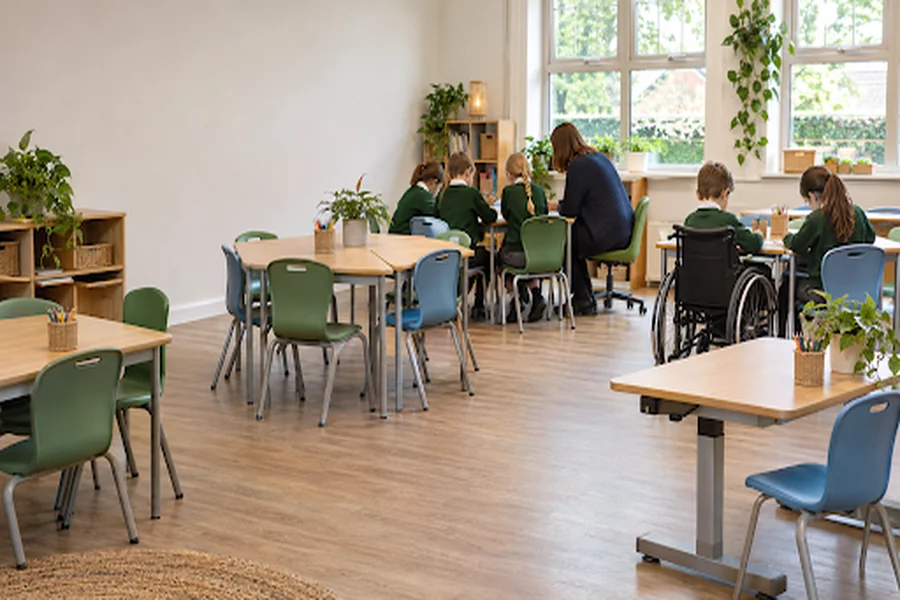
Desks that can alter in height are beneficial when considering how pupils will access the work in front of them. It can also allow a pupil that uses a wheelchair to have a suitable desk, depending on height, leg room and access.
According to the Department for Education, there are over 1.8 million pupils in England who were recorded as having Special Educational Needs (SEN). This could include pupils on SEN support or an education health and care plan (EHCP).
This does not mean every pupil with Special Educational Needs will require a different desk, but you want to allow your pupil to learn to the best of their ability.
When looking at school and classroom desks, ukeducationalfurniture.co.uk lists a variety of shapes, sizes and adjustable height desks.
Including all pupils in your classroom
As mentioned above, the height of a desk can be beneficial, but what about the location of a desk within your classroom?
Imagine you are a pupil that uses a wheelchair, if you cannot easily access your desk because of space around the desks, then your classroom is creating a barrier to your learning.
By placing your desks in certain locations, you can allow your pupils to access your classroom and resources more easily. Ensure you have space from the door, your whiteboard, resource areas and anywhere you may have a pupil working independently.
You also want to consider staff, as they may need to stand next to your pupil to aid them, so leave space around that desk.
There are many ways to do this, here are some suggestions:
- Keep bags and spare chairs out of the way
- Provide adequate space around desks that your pupils may use with wheelchairs etc.
- Place commonly used resources in areas that are easily accessible to pupils
- Consider where you place your desks when the classroom is full of pupils
Allowing access to your classroom is not only opening the door for your pupils, but allowing them to learn within it.
Creating flexible group work areas
There will be times that you want your pupils to work on their own, in pairs, in groups or doing a practical activity. Having your desks set out to do one thing, can be difficult when wanting to teach your lesson another way.
Tables can come in rectangular shapes, which can allow you to group them together to create bigger work surfaces, or separate to work individually. Some tables can also come in trapezoid shapes, which can allow you to bring them together for group work and pull them apart for independent work.
Your seating plan will vary depending on the activity, just make sure when changing your classroom, that it’s done quickly and efficiently.
A pupil that struggles to work in a big group, may work better next to one pupil, then move to a bigger group table for an activity that requires more support. Or they may need more room around their desk, due to additional equipment, but still be able to participate in the activity.
Will your pupils have access to the information they need, and are you not creating a barrier by moving your tables?
Ensure your classroom has a routine, and that your furniture can stay stable when required.
Minimising distractions
Some pupils can become distracted by noise, or items that are on their desk when learning. Although changing your furniture will not cure these problems, it can help reduce distractions within your classroom.
Are your pupils’ desks wobbly when they are writing? Do they make a lot of noise when moving across your floor?
Providing some type of storage, can allow your pupils to access common resources without overloading their desks.
Allowing a pupil to work in a quieter area doesn’t have to mean pulling them from your classroom, you can have their desk away from your main flow of traffic, giving them a calmer environment to learn in.
Choosing your school and classroom desks
So now you know what to consider when equipping your classroom, let’s go over some steps when purchasing your new furniture.
Allow room for your chairs, bags and equipment that your pupils will need.
Before you purchase your new school and classroom desks, think about:
- Will the pupil be able to sit, stand, and work at the correct height?
- Can your pupil access the desk, get in and out, and use it appropriately?
- Will the pupil have flexibility to move between different activities, and will they have space to do so?
- Are your desks practical, can you clean them, do they have stability and allow your pupil to access equipment?
- Have you discussed with your pupils, staff, parents, or professionals, about any individual needs your pupil may have?
Remember, as schools in England, you have responsibilities to create an accessible environment for your pupils with disabilities, and consider reasonable adjustments for them.
When you have your new desks, continue to monitor if they are working for your pupils. They may need to be changed, as your pupil grows, new pupils come into your class, or your activities change.
The Education Endowment Foundation states that modifications to your classroom can enhance, or limit your pupils’ learning. So do the same with your desks, ask yourself, can the pupil access what is being taught?
Summary
By understanding what barriers your pupils may have when learning, you can start to create an inclusive classroom for them. Some of these barriers can be as simple as your school and classroom desks.
Make sure your pupil has a desk that fits their needs, that they can access, and allow them to have flexibility when changing your classroom.