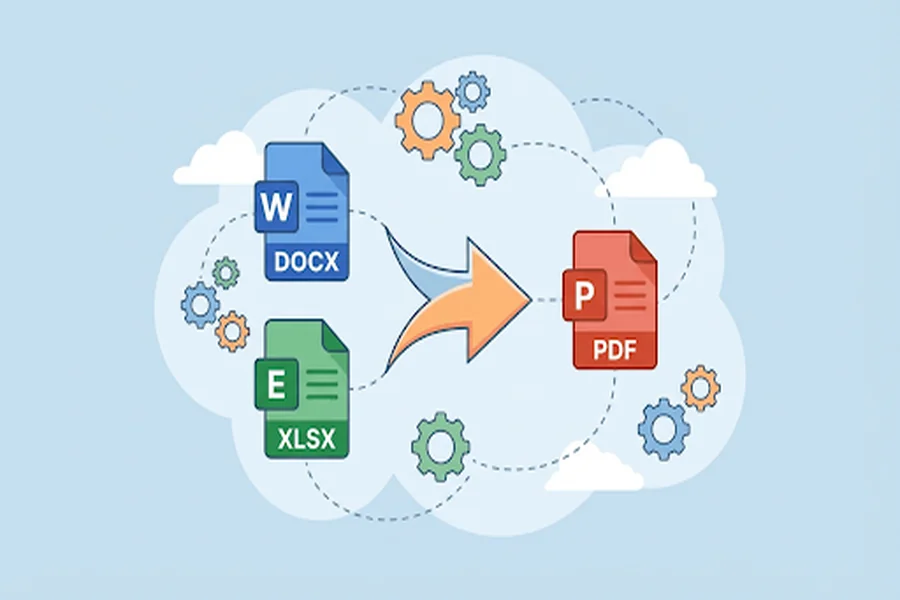
Free PDF converters provide users the ability to convert files such as Word, Excel, or images into PDF format at no cost. Most online utilities operate on phones and computers, which simplifies sharing work and school documents.
Certain converters even allow you to fix files, insert comments, or preserve page formatting. Choosing the best one depends on your individual needs and how secure the tool is.
Core Advantages
These free PDF converters are remarkable for helping you turn file management easy and consistent in most environments. They’re simple, ubiquitous and assist individuals to maintain documents at their prime, regardless of device or platform. These tools facilitate secure sharing and help keep sensitive info secure, all without added fees or hassle.
1. Universal Access
PDF converters online allow you to convert files simply by accessing a browser. You don’t have to download or install programs, so anyone with internet can access them. They run on Windows, Mac, Linux, iOS, and Android.
This unlocks possibilities for users on laptops, tablets, or phones in the office, at home, or on the go. Somebody in one country can send a Word report to a colleague on another continent, who reads it as a PDF on their phone, and nothing gets lost in the switch.
2. Document Integrity
This is the primary appeal of PDF converters — their ability to preserve a file’s visual formatting. When a spreadsheet or presentation is converted to PDF, the layout, fonts, and graphics remain intact. This is important for legal, business, or academic files where you need precise duplicates.
OCR support is a further bonus. Scanned images and documents get converted into searchable, editable PDFs, so you can actually do something with those old fill-out forms or printed reports. Quality converters process large, complicated documents without messing up tables, charts, or footnotes.
3. Reduced Size
PDF converters tend to compress file size. A 15 MB scanned contract could fall to 2 MB, for example, which is a lot easier to email or upload to a cloud drive. Smaller files make it quicker for workers sharing huge documents or students mailing term papers via dial-up. Many platforms allow you to batch convert, so five large photos can become five small PDFs at once, saving time and bandwidth.
4. Enhanced Security
Security is cattywampus already. Documents sent for conversion are frequently sent with SSL encryption, so information remains secret during transmission.
Most free PDF converters provide password protection or restrict file access post-conversion, which is great for sensitive files like invoices or HR documents.
Users can securely upload and convert medical records, contracts, or ID scans without concern for leakage.
5. Professional Polish
PDFs add an immediate, professional polish to any document. They look neat on slides, proposals, or reports. Most converters include options to add watermarks or digital signatures, providing an additional level of trust and authenticity. Even free versions allow users to try out these features, letting you test drive before paying.
File Versatility
Free PDF converters excel in file versatility, providing users with the freedom to convert various file formats. They allow users to convert DOCX, XLSX, PPTX, or images to PDF, enabling teams to collaborate without file compatibility concerns.
Simple file sharing across platforms is now de rigeur at both work and school. Batch processing, which lets users convert dozens of files simultaneously, accelerates big projects and simplifies workflows.
For Linux-like users, native utilities open up these possibilities even further. Online converters routinely restrict free users to less than 10MB files, which can be dicey for image-heavy layouts or extended manuscripts.
Yet, the majority will permit different files to be consolidated into one PDF, a useful option for reports, portfolios, or presentations that need to unify varied content.
Format Support
Newer converters will support the most popular formats, allowing users to convert between PDFs and regular office or image files. This versatility ensures nobody gets trapped with one file type.
- DOC, DOCX (Word)
- XLS, XLSX (Excel)
- PPT, PPTX (PowerPoint)
- JPG, PNG, BMP, TIFF (Images)
- TXT, RTF
- HTML
Almost all free converters accommodate at least these. Some will let you upload less common files, but accuracy decreases for more complex layouts or non-standard fonts. For teams hopping between devices or exchanging files among different programs, this format coverage is essential.
It helps you skirt compatibility issues, particularly when you’re sending files to clients or partners using different operating systems.
Image Handling
A free PDF converter can convert images such as JPG, PNG, and TIFF into PDFs. That’s beneficial for anyone who wants to submit scanned receipts, artwork, or photo albums in one convenient file. It’s all about quality, so numerous utilities claim they’ll maintain image detail crisp, with minimal loss from compression.
That’s key for graphic designers, architects, or students who want every last detail to display when they share work. Free converters will shrink large images or drop resolution to fit under their size limits.
A few converters allow you to customize the resulting PDF, like image quality or page size. This control assists in striking a balance between file size and clarity when posting online or archiving documents.
Scanned Documents
OCR, or optical character recognition, allows users to convert scanned PDFs into editable text. If you scan in a contract or an old letter, OCR can convert that image into an actual, searchable document.
Free rudimentary utilities tend to hit 50% accuracy for scanned files, so you’ll want to proofread. Paid tools, using smarter AI, can achieve 95% or better, making them safer for significant documents.
Searchable PDFs, thanks to OCR, can save hours for anyone who needs to search for keywords in lengthy documents. This helps make archives and compliance easier for businesses with lots of paperwork.
Your Data’s Safety
Free PDF converters are convenient. They carry actual dangers. When you upload files, particularly those with sensitive or personal information, data security has to be a priority. Certain sites scrape your documents for personal info.
They could infect your computer with ransomware or hijack your identity. There are even scam converters that install malware or serve as phishing traps. Spending a few minutes reading about a tool before using it can help you avoid hassles.
Easy measures, such as checking out user reviews or searching for security alerts, go a long way. Upload without a thought, and you risk your data, and at times, the price is far higher than a lost document.
Encryption
Encryption is a primary defense. The majority of trusted free PDF converters employ at least some encryption to safeguard files during transit between your device and their servers. The two most common types are SSL/TLS, which you see in the “https://” in your browser, and AES, which stands for Advanced Encryption Standard.
SSL/TLS secures the transmission so that data is not susceptible to interception by third parties. AES, meanwhile, locks down the file itself in flight. While some converters implement only rudimentary SSL, others pair SSL/TLS with robust AES-256 encryption, keeping prying eyes even more at bay.
Selecting a converter that employs robust, state-of-the-art encryption goes a long way. Weak or legacy encryption can leak sensitive information.
For example, if you’re digitizing tax forms, contracts, or medical records, robust encryption protects those files from snooping eyes. Below is a quick comparison of common encryption features among online converters:
| Encryption Type | Usage | Security Implications |
| SSL (basic) | In-transit file transfer | Can be weak if outdated |
| TLS (modern SSL) | In-transit file transfer | Stronger, industry-standard |
| AES-128 | File-level encryption | Good, but not top-tier |
| AES-256 | File-level encryption | Very strong, highly recommended |
| No encryption | None | Puts users at significant risk |
Deletion Policy
Automatic file deletion is another safety feature to check. A lot of free converters claim to remove files from their servers after a specific period, usually within an hour. This narrows the timeframe during which files would be available to other people.
If a converter lacks an automatic deletion policy, your files could linger online far too long, leading to potential exposure or misuse. Always seek transparent, documented policies on a converter’s site.
It’s smart to verify whether deletion is actually automatic or whether you have to delete files on your own. A few sites using fuzzy deletion verbiage have been blacklisted as dangerous or even as malware distributors. A robust deletion policy paired with clear terms is a good indicator that a converter values your privacy.
Server Location
Your converter’s servers’ location matters. Data in countries with weak privacy laws runs the risk of being accessed by third parties or government agencies.
For European Union users, GDPR compliance is crucial. Opting for a provider with servers based in the EU or countries with robust privacy legislation can provide additional reassurance.
Servers in well-regulated areas ensure that your data will be handled with more caution and in accordance with rigorous privacy laws. Servers in loosely regulated jurisdictions could jeopardize your data.
Notice that some conversion sites won’t disclose where their servers are, so you’ll want to seek transparency on this before uploading anything sensitive.
Navigating Free Tiers
Free PDF converters can be a convenient middle ground for users who want immediate access to basic features without paying. They’re often best for infrequent needs, such as converting a resume, merging receipts, or saving a page.
These tools have inherent limits that govern their availability to you. Being aware of these free tiers enables users to make informed decisions and prevent annoyances down the road.
Usage Limits
These free PDF converters usually draw the line on how much or how often you can use them. These caps can take many shapes.
- Daily Conversion Caps: Many tools allow only a set number of conversions per day, sometimes as low as two or three. This can bog down users who want to process multiple documents simultaneously.
- File Size Restrictions: Maximum file sizes are typical, usually 10 MB or less. Larger files either get rejected or you have to pay for an upgrade.
- Limited Pages per File: Some converters put a cap on the number of pages per document, which might be just ten or twenty.
- Supported File Formats: Free versions may only handle popular file types, like DOCX or JPG, leaving out less common formats unless you pay. A few tools support over 300 formats, but that is unusual on a free tier.
- Speed Throttling: Processing times can be slower for free users with queues or mandatory waiting periods.
- Session or Hourly Limits: A few services restrict how many files you can convert within a set time, such as one file per hour.
Knowing these limits allows users to plan accordingly. For big or complicated projects, batching or distributing over days can work. If your needs are simple and one-off, you might not feel the sting of these caps.
Quality Tradeoffs
Users of free PDF converters frequently sacrifice output quality for convenience. Some tools compress images or reduce resolution or sacrifice font fidelity, which impacts the final document’s aesthetics.
Premium features such as OCR, batch processing, or password protection are typically behind the paywall.
Free tools might transform files with sporadic glitches, such as shifted formatting, lost images, or illegible words. Try out a few converters with a sample file before putting important documents through the wringer.
It is better to be safe than sorry! Built-in options like “Print to File” in popular apps could provide more consistent results, albeit with less functionality.
Hidden Upsells
Many free PDF converters will try to upsell you with prompts, pop-ups, or time-limited offers. Premium features such as larger file sizes, additional formats, or advanced editing are regularly promoted once a conversion is completed.
Certain sites will make you sign up or enter payment info before you download, and they can auto-renew you unexpectedly or charge you a fee.
Read the terms and conditions before uploading sensitive files. Security issues like ambiguous file destruction procedures or possible leaks should be considered. Even if the service seems free, hidden costs, such as wasted time, privacy concerns, or reprocessing poor conversions, can swamp the upside.
The User Journey
The user journey through free PDF converters is one of easy wins and occasional peril. For the bulk of users, the journey begins with a hasty web search for a free option, only to stumble over secret limits, mysterious fine print, or unforeseen barriers.
At the heart of an excellent user experience is how fast and easy it is for someone to convert their documents, which has an actual, tangible effect on productivity and peace of mind.
Interface Design
A user-friendly interface is among the initial impressions. The top free PDF converters have easy-to-use interfaces with big buttons, descriptive labels, and clean screens. These design decisions assist users in locating essential capabilities quickly, like submitting a file or selecting an output format.
Platforms such as convertpdf.ai and iLovePDF are lauded for their sleek, focused interfaces, allowing users to begin conversion with minimal steps.
A convoluted or cluttered interface will gum up your people. Some, for instance, hide the conversion button behind pop-ups or ads. Others require you to register before viewing the dashboard.
Stress-free users should search for converters that don’t demand registration and display all steps up front. This reduces the learning curve and makes it accessible to more individuals—even ones with low digital literacy.
Conversion Speed
Speed is a competitive advantage for converters. A lot of free tools might be able to handle small PDFs within seconds, but when you have large files or batches, bottlenecks reveal themselves.
When dealing with bulk conversions, slow tools can rapidly consume all time and patience. Zamzar, for example, is speedy with single files but can be sluggish when you have a number queued up.
Fast conversions are not just a nice-to-have; they enable professionals to meet deadlines and maintain momentum. Delays, particularly when combined with daily quotas or waiting lists, accumulate and cause frustration.
Users will tell you that they waste an hour trying slow sites before they discover one that responds in seconds. For hard-core tasks, selecting a converter recognized for speedy, dependable service is essential.
Mobile Access
The ascendance of mobile-first work means folks are craving PDF conversion wherever they are. Most want things to just work seamlessly on phones and tablets with no feature drop-out and no additional steps.
ConvertPDF and Soda PDF have mobile websites, allowing you to upload, convert, and download files right from your device’s browser.
Other apps forego account creation altogether, a welcome feature for many users. The ability to transform a document in just a few taps while on your way to work or on vacation provides genuine convenience.
Folks appreciate the privacy and swiftness of apps that don’t request additional permissions or private information. Dependable mobile access can spare you both and save time and hassle by making your document work as easy as possible wherever life happens.
Making Your Choice
Selecting a free PDF converter is about more than just saving money. Readers want products that fit their workflow, value their privacy, and provide accurate results. Ranging from barebones web-based gizmos to full-featured desktop applications, the ideal selection varies according to your specific requirements.
Assess Needs
Begin by considering the type of files you’ll convert and how frequently. Most folks want an easy-to-use tool for quick, one-off tasks. Others require additional features, such as batch processing for a large number of files or OCR for scanned pages.
If you commonly flip-flop between formats like Word, Excel, PowerPoint, and JPG, see if the converter supports them all. The requirement to modify text or photos in PDFs might push you toward pricier capabilities, which aren’t always free. A drag-and-drop feature is a bonus for quickness and convenience.
- What kinds of documents will you convert most frequently, such as text, spreadsheets, and images?
- How frequently do you need to convert files, on a daily, weekly, or occasional basis?
- Do you handle scanned documents that require OCR?
- Is batch conversion important for your workflow?
- Are you looking for editing tools inside the converter?
- Would you prefer a web tool or installable software for greater control?
Prioritize Security
Security doesn’t only matter for highly sensitive files. It matters any time you upload personal or work documents. Free converters, particularly online ones, differ in how they process and keep files. Check to be sure it has encrypted uploads, a transparent privacy policy, and deletes files after conversion automatically.
Reviews and user ratings can indicate whether a tool adheres to minimum security standards or has experienced lapses. It is smart to review comments on the user data protection quality of a converter. If you’re handling sensitive papers, desktop software might provide more reassurance than web-based services.
Test Performance
Performance is the bane or blessing of the user experience. Testing a few converters is the best way to determine which provides maximum results for you. A free 14-day trial can usually allow you to try out the full functionality.
- Try two or three different converters. Mix online and downloadable ones for comparison.
- Try converting the same batch of files. Take note of the speed and convenience. Look for features important to you, such as drag-and-drop or batch processing.
- Check output quality: Are layouts, fonts, and images preserved? Go for OCR if you use scanned files.
- Record any limitations, such as daily caps or the loss of premium functionality.
Not all free tools are created equal. Some will cap you at a certain number of conversions per day or strip out editing features unless you pay.
Conclusion
To deal with files spanning formats, free PDF converters come to the rescue. They allow you to move documents quickly, secure them, and provide you with the space to experiment risk-free. A great tool saves time and keeps your stuff in order.
Some tools are all about speed, some provide a greater number of file types, and some promise stringent data locks. For people who want less hassle, most of these utilities operate directly inside your browser, no downloads, no lengthy wait.
No more trial and error; select the one that suits your work style. Try a few to see what fits. For additional hacks and tool selections, read through our complete guide and share what works for you.