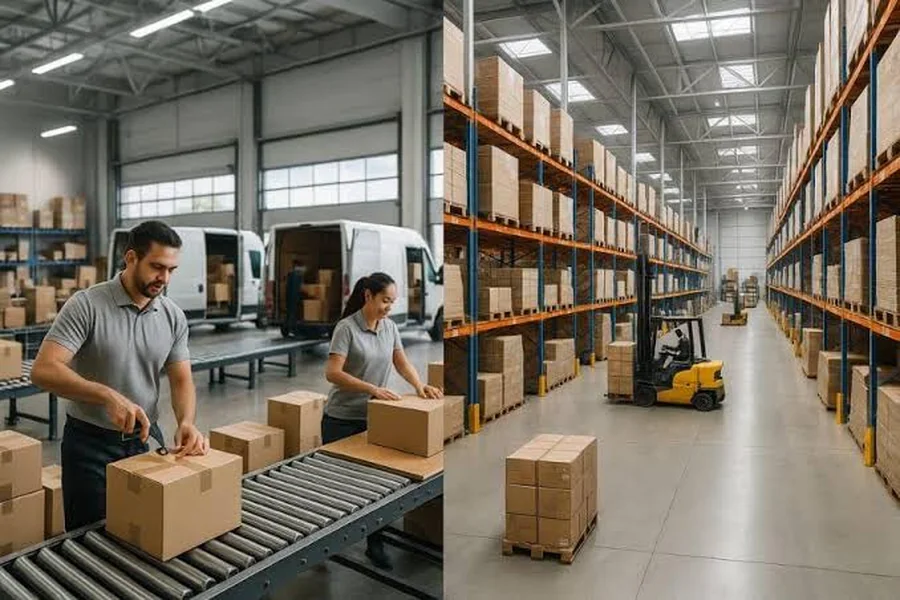
A second warehouse shortens delivery for nearby customers but adds stock, handling, and admin costs for everyone else. Road and port links usually matter more than the number of sites. Most UK sellers are better served by one well-placed site until a single overseas market justifies a second.
Ask a UK seller where their stock should live and the first instinct is often “closer to the customer, so more sites”. It sounds sensible, but it’s often wrong. The right answer depends on where your orders come from and what each extra building costs you.
Does a Second Warehouse Really Make Delivery Faster?
Yes, but only for people nearby. Moving stock to the Netherlands or Germany can cut a four- to seven-day delivery to one to three days for EU buyers and remove most customs paperwork from each parcel. For a customer in Leeds, nothing changes.
That unevenness is why the decision should start with an order map, not a provider brochure. Anyone drawing up a shortlist of the best fulfilment companies UK sellers actually use should ask each one how a second location would work, and whether stock can be split without doubling your admin. A provider’s building count tells you very little about how well it serves your particular customers.
Which Sellers Should Stay With One Site?
Most of them, at least at first. A single central site is hard to beat when orders are concentrated in one country, volumes are modest, or the catalogue is wide and slow-moving, because splitting slow sellers across two warehouses means they sit unsold in both.
The grid below sets out how the decision usually falls for common seller profiles.
| Your situation | Better fit |
| Over 85 per cent of orders ship within the UK | One UK site |
| A steady, growing share of orders go to a single EU country | UK site plus one EU site |
| Large catalogue, many slow-moving products | One site, with fast sellers prioritised |
| Orders spread thinly across many EU countries | One UK site with consolidated freight |
| Customs delays visibly hurting EU conversion | Test an EU site on your top products |
None of these is a rule, and the figures are rough guides, not thresholds. They show that a second site responds to concentrated demand, not a default upgrade.
Why Does the North West Keep Coming Up?
Because roads, not postcodes, decide how fast a parcel moves. The North West sits on a dense web of motorways and A roads, close to the Port of Liverpool and Manchester Airport, and within a few hours’ drive of most of the UK population. A warehouse there can hand parcels to carriers late in the afternoon and still reach most addresses the next day.
Regional business history backs this up. The story of the A57 helping local business to thrive is a good reminder that trade settles where transport is easiest, and logistics firms have followed the same logic for a century. The same test applies abroad: before choosing an EU site, check its distance from carrier hubs, ports and border crossings. A cheap unit far from the network usually loses its savings in later cut-offs.
What Does the Second Site Cost You?
More than its size suggests. Each location needs its own safety stock, so total inventory rises even if sales do not. You pay a second set of storage and handling fees, plus freight to get stock to the new site in the first place. If the site is in the EU, expect to register for VAT there too.
Take a seller whose EU orders make up a fifth of volume. Moving stock to the EU can save two or three days on those parcels, but the same seller now forecasts demand in two places, and any misjudgment leaves stock stranded on the wrong side of the border. Rebalancing between sites costs freight and time. The speed gain is real, but it must outweigh a permanent increase in complexity.
How Do You Decide Without Guessing?
Use your own data. Export 12 months of orders, group them by destination country, and flag where delivery times or customs issues are hurting conversion or reviews. Then estimate how many days a local site would save on those parcels and what that is worth against the extra monthly cost.
If the saving is small or spread thinly, stay put and improve your consolidated freight instead. If one market clearly stands out, pilot a second site with your fastest sellers only, and judge it over a full quarter before moving anything else.
Frequently asked questions
Does a second warehouse always speed up delivery?
Only for customers near it. The gain is large in the new market and close to zero elsewhere.
What does a second location cost?
Extra safety stock, additional storage and handling fees, inbound freight, and EU VAT registration if the site is in the EU.
Why is the North West a good place for a UK warehouse?
It has dense motorway links, a major port and a nearby airport, and reaches most UK customers within a few hours.
When should I add an EU warehouse?
When one EU market produces a large and growing share of your orders and delivery times or customs delays are costing you sales.