
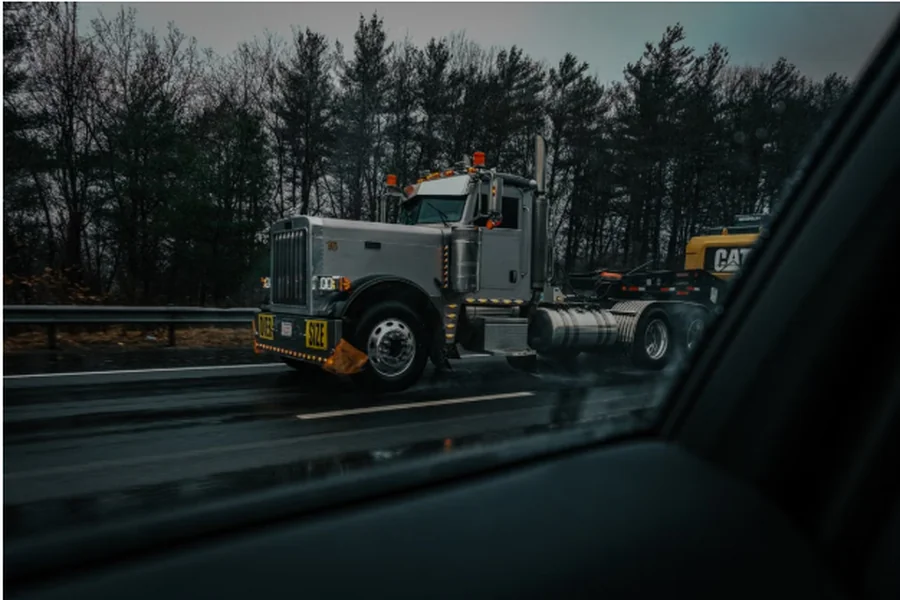
Got sideswiped by an 18-wheeler and expect your claim to go smoothly like a regular auto accident?
Think again.
Truck accident claims are a completely different animal. After that point, however, the two claims diverge in vastly different ways. Handling truck claims involves:
- More people to blame
- Bigger insurance policies
- A thick stack of federal rules
Here’s the problem:
Many people realize this AFTER the insurance company has already beaten them by three steps.
Let’s break it down…
Inside This Guide:
- What Makes A Commercial Truck Accident Claim Different?
- More Than One Party Can Be At Fault
- Federal Rules Change Everything
- The Evidence Disappears Fast
- The Stakes (And The Fight) Are Much Bigger
What Makes A Commercial Truck Accident Claim Different?
A commercial truck accident claim arises when you collide with a big rig, delivery truck or other vehicle used for business purposes. On paper, there is nothing different about a truck claim than a car accident claim. An injury occurred. Someone else was responsible. You expect compensation for your damages.
But that’s where the likeness ends.
In most car wrecks there is one driver and one insurance company. When you add a commercial truck into the equation, you can be facing the truck driver, trucking company, loading dock employees and a team of attorneys that work for the carrier. For this reason many victims hire a truck crash lawyer right away. A commercial truck accident claim involves more players, stricter federal regulations and significantly more insurance money than your average car wreck.
And the injuries are often much worse.
New federal data reveals that 5,472 people died in large truck crashes in 2023. Most of those people were not in the truck. Most of those people were in small vehicles, on foot or on bicycles. Adding insult to injury, another 153,452 were injured in large truck crashes in 2023.
Think about it:
An 18-wheeler fully loaded will many times outweigh your family vehicle. When an object that large collides with your car, you can expect significant damage. Significant damage leads to more medical treatment. And more medical treatment means higher motivation for the other side.
More Than One Party Can Be At Fault
This is the first big difference.
When two cars collide, there’s typically one driver who is at fault. When a truck crashes, liability may spread through an entire network of individuals and businesses. These may include:
- The truck driver: for speeding, texting or driving tired.
- Trucking company: Poor hiring practices, inadequate training or pressuring drivers to meet unrealistic deadlines.
- The cargo loader: for overloading the trailer or not tying down freight
- The truck or parts maker: for faulty brakes, tires or steering.
- The maintenance shop: for skipping repairs
They will all want separate insurance policies. And they will all try to blame someone else.
Pretty messy, right?
Determining liability can be time consuming and involve some actual digging. However…. There is a bright side. More wrongdoers = more pockets to fill your damaged.
Federal Rules Change Everything.
Car drivers have state traffic laws to follow. Truck drivers and trucking companies follow those laws also… and a hefty rule book from the Federal Motor Carrier Safety Administration (FMCSA) as well.
These rules cover things like:
- How many hours a driver can be on the road
- Drug and alcohol testing
- Truck inspections and repairs
- How much weight a truck can carry
And here’s the kicker…
Were any of these violations broken by a trucking company? If so, it can significantly strengthen your claim. A driver exceeding their hours was probably tired. An uninspected truck could have had faulty brakes.
Statistics from the transportation industry reinforce how significant these violations are. According to the American Transportation Research Institute (ATRI), when crashes involved hours-of-service or logbook violations, the injured party prevailed in 100% of cases.
The problem is you have to be able to prove it happened. Which means getting access to the appropriate records while they still exist.
The Evidence Disappears Fast
Evidence for car accidents is pretty basic. Photos, police report, and perhaps a witness or two.
Evidence in truck accidents extends much further. Nearly all tractor trailers are equipped with electronic logging devices (ELDs) and electronic “black box” data recorders. These record a truck’s speed, braking, hours of service and GPS location. This can paint a picture of what exactly took place during the moments leading up to the collision.
But there’s a problem…
Trucking companies are only required to preserve certain of these documents for a limited period of time. Once that window passes, the information can be legally erased or overwritten. Hence, speed is of the essence. Your spoliation letter (a letter formally requesting the company preserve all evidence) should be sent immediately.
Other key evidence in a truck claim includes:
- Driver hiring files and training records
- Drug and alcohol test results
- Maintenance logs
- Dispatch messages and phone records
The longer you wait, the harder it gets to find.
The Stakes (And The Fight) Are Much Bigger
Here is where truck claims really split away from car claims.
Liability limits on most auto insurance policies are quite low. Commercial trucks are another story. Federal law mandates most interstate trucking companies hauling property to have at least $750,000 liability insurance. Many have much higher limits.
The more money that is at stake, the more the insurance company will fight to keep it. It’s not uncommon for trucking companies to have their own response teams at the scene of a crash within hours. They have one job. Defense.
…and larger and larger awards are getting handed down with more frequency. ATRI found the median dollar amount for a nuclear verdict ($10 million or more) reached $36 million in 2022. This is why trucking insurers defend every commercial truck accident claim vigorously…and why they fight tooth and nail before making a reasonable offer.
Tip: Every state has a time limit for filing an injury claim. In Texas, you generally have two years from the date of the crash.
The Bottom Line On Truck Claims
Truck accident claims are inherently more complicated than car accident claims. Here’s why. They:
- Multiple parties who may share the blame
- Strict federal rules that can help prove fault
- Evidence that can disappear quickly
- Big insurance policies backed by aggressive legal teams
Dealing with a car accident claim can be an individual battle. Handling a truck accident claim is battling an entire corporation.
The good news is that understanding these differences can put you in a much better position. Seek medical attention immediately, keep all paperwork and act quickly before evidence disappears.
Frequently Asked Questions
Who pays for a truck accident claim?
Compensation typically comes from the insurance policies of the liable parties. This can include the trucking company, driver, cargo loader or even parts manufacturer.
Is a truck accident claim worth more than a car accident claim?
Usually, yes. Truck accidents generally lead to more severe injuries. Also, commercial carriers have significantly higher insurance limits. However, each claim is unique and worth varies based on the circumstances of the accident.